If you're experiencing hot flushes, poor sleep, brain fog, joint pain or mood changes and you're in your 40s or 50s, you may be a candidate for hormone replacement therapy — commonly known as HRT. In Ireland, more women than ever are seeking information about HRT, yet many don't know where to start or what to expect.
This article explains what HRT is, what options are available in Ireland, who it's suitable for, and how to access it through your GP.
What is HRT?
HRT replaces the hormones — primarily oestrogen and progesterone — that your body produces less of as you approach and go through menopause. These hormones affect almost every system in the body, which is why their decline can trigger such a wide range of symptoms.
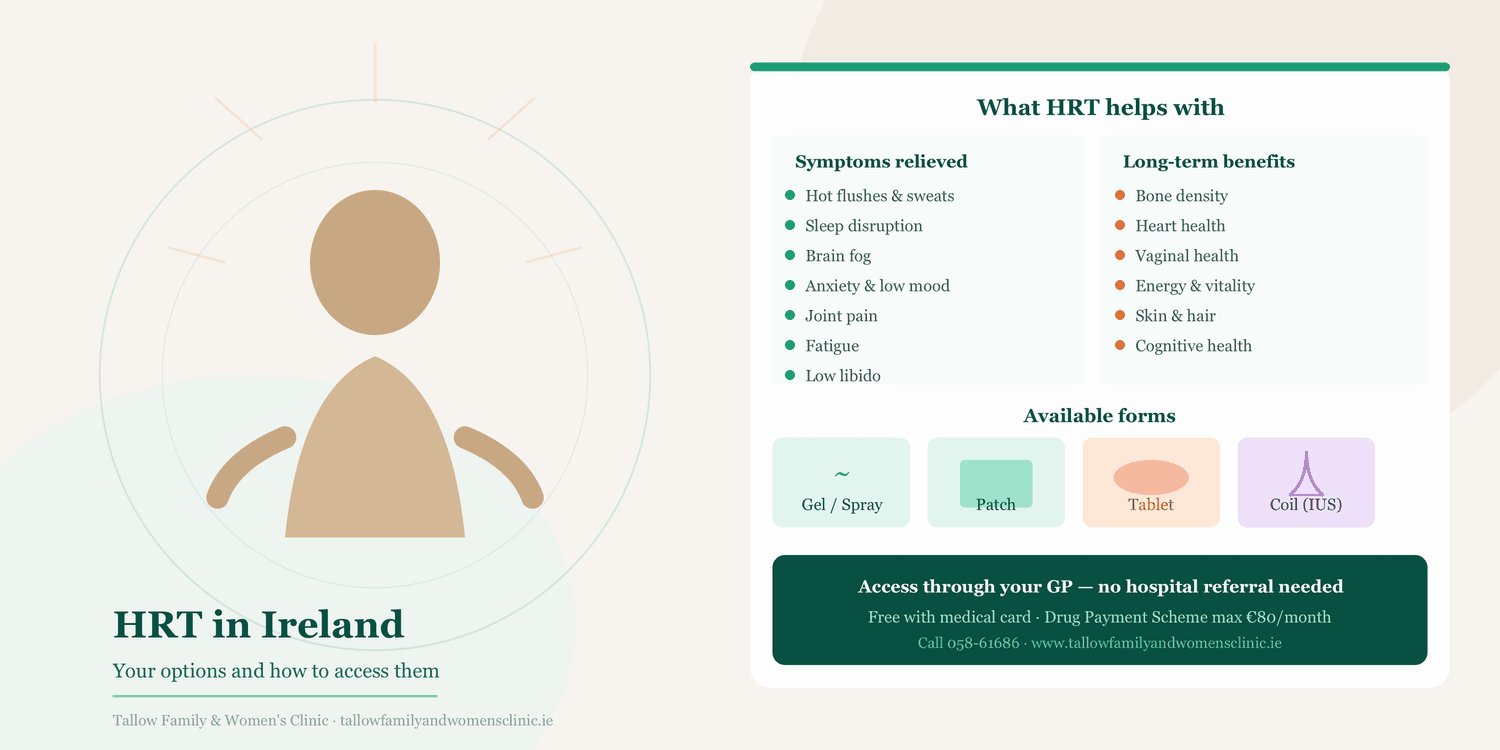
For many women, HRT is the most effective treatment available for menopausal symptoms. It can significantly reduce or eliminate hot flushes, improve sleep, lift mood, restore energy, protect bone density, and improve sexual health. For some women, the improvement in quality of life is transformative.
Is HRT safe?
HRT has had a complicated reputation, largely stemming from a flawed study published in 2002 that overstated its risks. The medical consensus has shifted considerably since then. Both the British Menopause Society — of which our practitioners are members — and the Menopause Society of Ireland now support the use of HRT for most healthy women under 60 who are within ten years of their last period.
For women in this group, the benefits of HRT generally outweigh the risks. Your GP will take a full medical history and discuss your individual circumstances before recommending HRT.
What types of HRT are available in Ireland?
There are several forms of HRT available, and the right option depends on your symptoms, your medical history, and your personal preferences.
Oestrogen-only HRT is suitable for women who have had a hysterectomy. It is available as patches, gels, sprays and tablets.
Combined HRT — oestrogen plus progesterone — is for women who still have a womb. The progesterone protects the lining of the womb. It is available as patches, tablets, and combinations using the Mirena coil for the progesterone component.
Body-identical HRT uses hormones that are chemically identical to those your body produces naturally. These are available on prescription in Ireland and are the preferred option recommended by the British Menopause Society. Common examples include Estrogel (oestrogen gel) and Utrogestan (micronised progesterone capsules).
Testosterone is sometimes prescribed for women experiencing low libido and fatigue that doesn't improve with standard HRT. It is used at much lower doses than in men and can be very effective.
How is HRT taken?
The method of delivery matters. Transdermal HRT — gels, patches and sprays applied to the skin — is generally preferred over tablets because it carries a lower risk of blood clots. This is because transdermal oestrogen is absorbed directly into the bloodstream rather than passing through the liver.
Gels are applied daily to the thigh or upper arm. Patches are changed once or twice a week. Tablets are taken daily. The Mirena coil, if already being used for contraception, can serve as the progesterone component of HRT — meaning you may only need to add a topical oestrogen.
How do I access HRT in Ireland?
Your first step is to speak to your GP. At Tallow Family and Women's Clinic, we offer specialist menopause consultations through our Munster Menopause Clinic service. During your appointment, we will:
Review your symptoms using a validated menopause symptom scorecard
Take a full medical history
Discuss the different HRT options available to you
Agree a treatment plan and starting dose
Arrange follow-up to review how you are getting on
You do not need a referral to a hospital specialist to access HRT. Your GP can prescribe it directly.
Does HRT cost money in Ireland?
HRT prescriptions are covered by the Drug Payment Scheme, which means the maximum you will pay per month for all prescriptions combined is €80. If you have a full medical card, HRT is free. Many women find that once their symptoms are controlled, the cost is modest relative to the improvement in their quality of life.
How long will I need to take HRT?
There is no fixed rule. Some women take HRT for two to three years to get through the most difficult phase of menopause. Others continue for longer, particularly for the bone-protective and cardiovascular benefits. The decision is reviewed regularly with your GP based on how you are feeling and any changes in your health.
Is it too late to start HRT?
For most women, the ideal window is within ten years of the last period and before age 60. Starting HRT in this window carries the best balance of benefits and risks. Women who are older or further from menopause are assessed individually.